



Beyond the Winning Product: How to Build a Dropshipping Product Strategy for Growth



Finding a product that generates sales is an important milestone for any dropshipping store. It proves that customers are interested and that the market may be worth exploring further.
But one successful product is not a complete product strategy.
Long-term growth requires sellers to understand why customers buy, what related needs they have, and which products can strengthen the store rather than simply enlarge its catalog.
A thoughtful dropshipping product strategy can help sellers serve more customer needs, build a clearer store identity, create relevant cross-selling opportunities, and reduce dependence on a single item.
The goal is not to add as many products as possible. It is to build a product mix in which every item has a clear role.
Why One Winning Product Is Not Enough
A winning product provides useful information about:
- Who your customers are
- What problems they want to solve
- Which benefits attract attention
- What price range they may accept
- Which marketing messages generate interest
However, it does not automatically explain what your store should sell next.
Many sellers respond to a successful product by increasing advertising spend. That may support short-term growth, but relying on one item alone can create risks. Demand can change, competition can increase, advertising costs can rise, and supplier conditions can become less favorable.
Customers may also have related needs beyond their first purchase.
For example, someone buying a travel bag may also need packing organizers, luggage tags, cable organizers, or compact toiletry storage.
A stronger product strategy begins by looking beyond the individual item and asking: What broader customer need does this product reveal?
This question can guide sellers toward relevant products instead of a catalog filled with unrelated trends.
A focused product mix also makes a store easier to understand. A store offering phone cases, pet toys, kitchen tools, and beauty products may struggle to create a clear identity. By contrast, a store focused on small-space organization can connect drawer dividers, closet organizers, kitchen storage, and cable management around one recognizable purpose.
Products do not have to belong to exactly the same category. They need to make sense for the same customer, problem, or use case.
Five Roles Products Can Play
Not every product needs to become the store’s next bestseller. Different products can support different business goals.
A practical product strategy begins by assigning each product a role.
1. Hero Products
A hero product is one of the main reasons customers visit the store.
It usually addresses a clear problem, has benefits that are easy to demonstrate, and provides a strong starting point for advertising or content.
A hero product can attract customers while also revealing opportunities for related products.
2. Complementary Products
Complementary products support the hero product or solve a closely related problem.
For example:
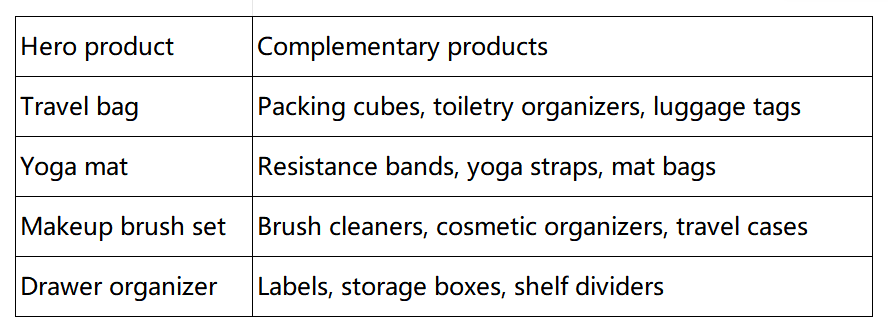
These products can create natural cross-selling opportunities because customers can easily understand why they belong together.
3. Bundle Products
Bundle products combine several items into a more complete solution.
For example, a “Carry-On Organization Set” might include packing cubes, a toiletry pouch, a cable organizer, and a laundry bag.
A useful bundle should make the buying decision easier or help customers complete a task. It should not be a random group of products offered together only to increase the order value.
4. Repeat-Need Products
Repeat-need products give customers a realistic reason to return.
Depending on the category, customers may repurchase because they need a replacement, want another configuration, plan to use the product in a different room, or are buying it as a gift.
Not every product naturally creates repeat purchases. Sellers should identify a genuine return scenario instead of assuming customers will buy again.
5. Test Products
A test product helps sellers explore an adjacent need, use case, price point, or category.
For example, a seller could test whether customers who buy compact travel storage products are also interested in portable cable organization.
The purpose is to gather evidence before making a larger catalog or marketing commitment.
How to Choose the Next Product
Before adding a new item, sellers should evaluate more than its popularity or sourcing price.
Five questions can help determine whether it belongs in the store.
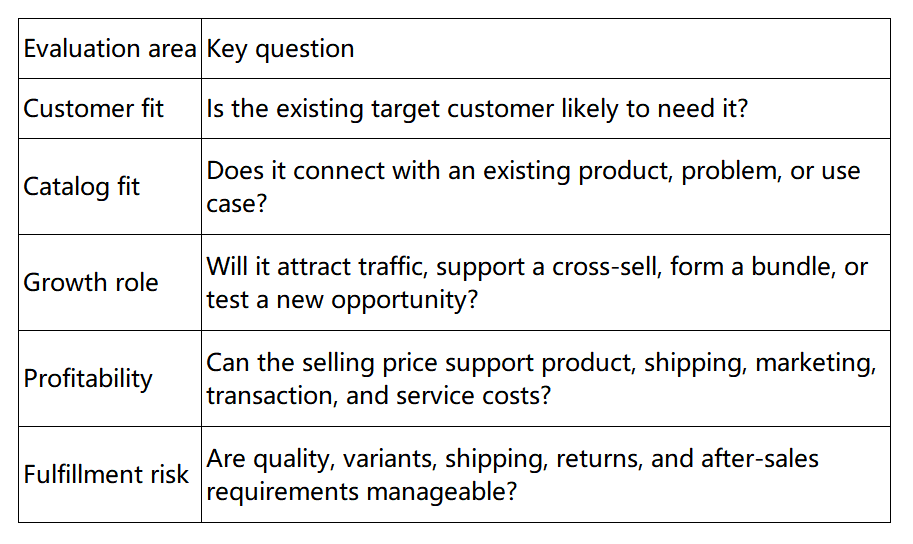
A product does not have to be perfect in every area, but its strengths and risks should be clear before testing begins.
The relationship between products is especially important. Two items may fit together because they:
- Serve the same customer
- Solve different parts of the same problem
- Appear in the same use case
- Support a before-and-after process
- Work as a main product and accessory
- Offer different price or feature levels
Sellers should be able to explain the connection in one sentence. If the relationship is difficult to describe, the product may weaken the clarity of the store.
Profitability should also be evaluated beyond product cost. A low sourcing price may be offset by shipping costs, advertising expenses, refunds, replacements, or customer-support requirements.
The relevant question is not simply: Is this product cheap?
It is: Can this product create a healthy return after the full cost of selling and fulfilling it?
A Practical Product Expansion Example
Imagine that a store’s current hero product is an adjustable drawer organizer.
The customer is not only buying a divider. The broader need may be:
I want to reduce clutter and organize a small living space without installing permanent storage furniture.
That need can lead to several related product opportunities.
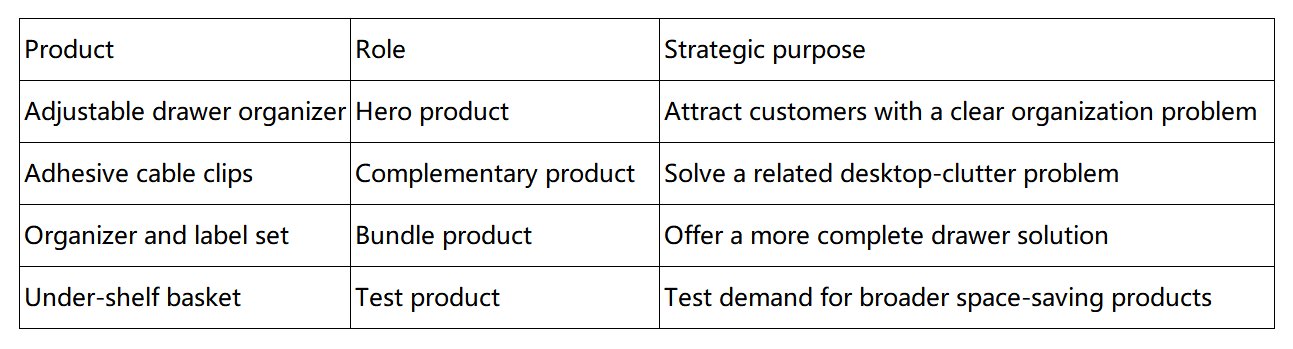
The seller does not need to add every possible storage product immediately.
A more controlled approach would be to begin with one complementary product, one bundle idea, and one adjacent test product. This creates enough variety to learn without making the catalog unnecessarily difficult to manage.
The same approach can work in other niches:
- A travel store can expand from luggage to packing and portable organization.
- A fitness store can expand from yoga mats to training accessories and storage.
- A beauty store can expand from makeup tools to cleaning, organization, and travel accessorie.
The expansion should follow customer needs rather than category labels alone.
Test Before You Expand
Adding a product to a store does not prove that it belongs there. A structured test helps sellers decide whether to keep, improve, expand, or remove it.
1. Define the Product’s Role
Decide what the product is expected to do.
Is it intended to:
- Attract new customers?
- Generate add-on purchases?
- Increase average order value?
- Support a bundle?
- Test an adjacent category?
The right success indicator depends on the role.
2. Set a Test Hypothesis
Define why customers may want the product.
For example:
Customers viewing our travel bag may also add packing cubes because both products support carry-on organization.
A specific hypothesis makes the results easier to evaluate.
3. Track Relevant Indicators
Possible indicators include:
- Product-page engagement
- Add-to-cart rate
- Conversion rate
- Cross-sell attachment rate
- Average order value
- Margin per order
- Refund or return rate
- Customer feedback
Revenue alone does not show whether a product is sustainable. Sellers should also review marketing costs, fulfillment performance, discounts, refunds, and support requirements.
4. Make a Decision
At the end of the test, select one of four actions:
- Keep: The product meets its intended goal.
- Improve: Interest exists, but pricing, positioning, content, or targeting needs adjustment.
- Expand: The product reveals demand worth exploring further.
- Remove: The product does not support customer needs, profitability, or store positioning.
A strong product strategy includes both an expansion process and a removal process.
Finding New Opportunities With DSers 1688 Dropshipping
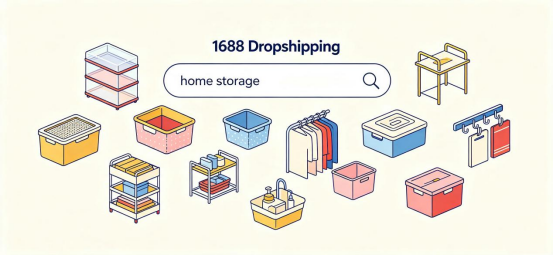
As a store grows, finding relevant products consistently can become challenging. Sellers need more than a large selection—they need a repeatable way to explore products that match their customers and business direction.
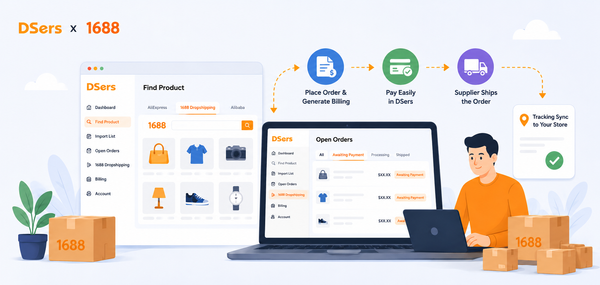
DSers 1688 Dropshipping allows sellers to explore products available through 1688 within the DSers product-sourcing workflow.
Instead of browsing without direction, sellers can use their product strategy to guide discovery.
Search Around Customer Needs
Start with keywords connected to a customer goal or use case, rather than searching only for the current product name.
For a travel-focused store, this could include:
- Carry-on organization
- Travel cable storage
- Compact toiletry storage
- Portable clothing storage
Searching around customer needs can uncover products from different categories that still belong in the same store.
Explore Similar Ideas With Image Search
When sellers already have a visual reference, image search can help them explore similar products or potential sourcing alternatives.
This can be useful when the right keywords are unclear or when a product idea was discovered on another website or platform.
Review Products Before Importing
Before choosing a product, sellers should review relevant information and consider:
- Product cost
- Shipping availability
- Options and variants
- Product presentation
- Potential selling price
- Catalog relevance
- Fulfillment and after-sales risks
The cheapest option is not always the best fit. Product quality, shipping, variants, and service requirements can all affect the customer experience and final margin.
Prepare Suitable Products in the Import List
Products that pass the initial review can be added to the DSers Import List for further preparation.
Before pushing a product to a connected store, sellers can review and edit elements such as its title, description, images, variants, and pricing.
This creates a clearer workflow:
- Define the customer need
- Decide the product’s role
- Search for relevant ideas
- Review product and fulfillment factors
- Add suitable candidates to the Import List
- Prepare the listing
- Run a limited test
- Keep, improve, expand, or remove the product
DSers can make product discovery and preparation more efficient, but sellers should still validate demand, profitability, supplier conditions, and customer experience before scaling.
Common Product Mix Mistakes
Adding Products Without a Clear Purpose
More products do not automatically create more growth.
Each new item should serve a defined customer, connect with the existing catalog, and perform a clear role. Otherwise, it may add management complexity without adding strategic value.
Chasing Every Trend
Trending products can create opportunities, but they may not match the store’s audience or positioning.
Before testing a trend, sellers should consider its customer relevance, catalog connection, potential longevity, and fulfillment risks.
A trending product can still be tested, but it should be treated as a deliberate experiment rather than an automatic change in store direction.
Expanding Too Quickly
A larger catalog requires more product updates, marketing content, supplier monitoring, customer support, and performance analysis.
Testing a small number of carefully selected products is usually more manageable than adding many items at once. Sellers can use the results of each test to guide the next round of expansion.
Conclusion
Build a Product System, Not Just a Larger Catalog
A winning product can help a dropshipping store begin growing, but it should also become a source of information.
It can reveal who the customers are, which problems matter to them, and what related opportunities may be worth testing.
The next step is not necessarily finding another isolated bestseller. It is building a product system in which:
- Hero products attract the right customers
- Complementary products support related needs
- Bundles create more complete solutions
- Test products explore adjacent demand
- Every item reinforces a clear store direction
Start with the customer, define the role of each product, evaluate new ideas consistently, and expand in controlled steps.
Sellers can then use DSers 1688 Dropshipping to explore relevant product ideas, prepare suitable candidates, and turn product discovery into a more deliberate part of their growth strategy.
Frequently Asked Questions
Here are some common questions about eBay Business Policies and how sellers can align them with real fulfillment workflows.
|
|
Get Started Now to Grow Your Online Business with the Best Dropshipping Tool - DSers! |




 Live Chat
